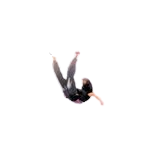
Choi Seunghee (Sai Shoki)
Choi Seunghee/Sai Shoki is a Korean modern dance pioneer who rose to fame in the 1930s alongside the likes of Martha Graham and Mary Wigwan. She greatly influenced the development of modern dance in East Asia by hybridising the different movement vocabularies and pedagogies between the east and the west. Despite her immense impact on the development of modern dance globally, her role has been neglected outside of East Asia due to World War II, North Korean regime, and exclusion from the Western Art canon. Choi Seunghee's main goal was to elevate the ‘lowly’ folk dance form to one that could be respected the same way Chinese opera and modern dance were respected at that time. Her apprenticeship with Ishii Baku - a prominent Japanese modern dance choreographer encouraged her to integrate Korean and Chinese folk dance with European modern dance, creating modernised versions of traditional dances such as the Janggochum and Salpuri. During her international tours around Europe, she collaborated with leading artists in varying artistic disciplines including Pablo Picasso and Jean Cocteau which facilitated the exchange and subsequent hybridisation between east and west dance cultures which we can observe in Wigman’s use of non-western accompaniment.
Her explorations with hybridity have influenced the stylisation of current East Asian contemporary dance, resulting in a movement language centred around grounded and fixed positioning of the pelvis, and biotensegrity drawn from martial art influences. You can notice these idiosyncrasies in Jemma Lee and Nam Hwayeon’s work – both prominent Korean contemporary artists.
Choi Seunghee remains historically visible in East Asia with recreations of her Folk-influenced repertory broadcasted on South Korean national television. However, her historical visibility outside of East Asia has significantly diminished due to three main reasons: Firstly, as a result of World War 2 and the Korean War, her international tour was abruptly truncated, and she was enlisted to perform energetic folk-influenced dances for the Japanese army. After the surrender of Japan and the beginning of the Korean War, she moved her dance school to Beijing losing a large proportion of her Korean student base. After accusations of collaboration with the Japanese during the Korean War, she defected to North Korea and established the Choi Seung-hee State Research Institute for Dance where many of her surviving students were educated. The purging of North Korean artists and intellectuals during the regime’s 1950s campaign against ‘revisionism’ and the restriction of her students from leaving North Korea has been the largest contributing factor to the diminishment of her modern dance legacy. Another reason for her reduced historical visibility is the nation-state system of recording dance genealogy which neglects modern dance evolution outside of the United States and European (German) centres. Despite her immense impact on modern dance, due to the East Asian folk origins of her practice, her contribution is often neglected as it doesn’t fall within the Eurocentric lineages of modern dance. Choi Seunghee’s influences on modern dance were less widely adopted as dance practitioners outside of East Asia lacked the pre-requisite knowledge and movement vocabulary of Asian folk dance to achieve the hybridity of Choi Seunghee’s practice whereas American and European modern dance adopts a more culturally apathetic approach that requires little to no understanding of American or European culture the execute the style. We also of course cannot deny the ongoing racism and discrimination against Asians, especially in the years after World War 2 which has further slashed the legacy and influence of East Asian modern dance pioneers such as Choi Seunghee by excluding them from the Western art canon diminishing their influence to one of orientalism and exoticism, and limiting their interaction with American modern dancers. For example, the Chinese Exclusion Act prevented immigration of all Chinese people which later extended to those of Japanese and Korean descent. It was enforced actively by the Asiatic Exclusion League up until 1942.
Reference List:
57 Studio. (2020). Hwayeon Nam, Mind Stream _Document Film [Video]. Retrieved 12 April 2022, from https://www.youtube.com/watch?v=ZZFMgTvFsLA.
An, S. (2020). Fragmented memories of Korea’s first modern dancer Choi Seung Hee [Video]. Retrieved 12 April 2022, from https://www.youtube.com/watch?v=feXexNyCgtc.
Arirang Culture. (2015). Arirang Prime-Dance Legend Choi Seung-hee 전설의 무희 최승희 [Image]. Retrieved 12 April 2022, from https://www.youtube.com/watch?v=c_-21v_rrn0&t=4s.
File, C. (2013). Korean Dance: Pure Emotion and Energy. Seoul Selection.
Hoshino, Y. (2016). Use of Dance to Spread Propaganda during the Sino-Japanese War. ATHENS JOURNAL OF HISTORY, 2(3), 193.-198. https://doi.org/10.30958/ajhis.2-3-3
Kim Young-Hoon. (2006). Border-Crossing: Choe Seung-hui’s Life and the Modern Experience. Korea Journal, 46(1), 170–197.
Kleeman, F. Y. (2014). Dancers of the Empire. University of Hawaii Press.
Lee, J. (2021). 담담히 적시고나 / A Film by Jemma Lee [Video]. Retrieved 12 April 2022, from https://www.youtube.com/watch?v=Vg0dkqnrkfg&t=160s.
Maison des Cultures du Monde - Centre français du patrimoine culturel immatériel. (2015). Hommage à Choi Seung-hee (Corée) [Image]. Retrieved 12 April 2022, from https://youtu.be/Hb6PeK61iRQ.
Manning, S. (2019). Dance History. In The Bloomsbury Companion to Dance Studies (pp. 303–326). London,: Bloomsbury Academic. Retrieved April 12, 2022, from http://dx.doi.org/10.5040/9781350024489.ch-011
Park, S., 2006. The Making of a Cultural Icon for the Japanese Empire: Choe Seung-hui's U.S. Dance Tours and "New Asian Culture" in the 1930s and 1940s. Positions: East Asia Cultures Critique, 14(3), pp. 597-632.
Van Zile, J. (2013). Performing Modernity in Korea: The Dance of Ch’oe Sŭng-hŭi. Korean Studies, 37, 124–149. http://www.jstor.org/stable/24575279
Wilcox, E. (2019). Revolutionary Bodies: Chinese Dance and the Socialist Legacy. The Journal Of Dance Society For Documentation, 53, 301-307. https://doi.org/10.26861/sddh.2019.53.301 문화예술의전당. 한국무용가 -최승희 -불꽃처럼 바람처럼-룰루처럼 딩가딩가 [Video]. Retrieved 12 April 2022, from https://www.youtube.com/watch?v=X1cQu93-Fas.
조선무용KOREAN DANCER. (2020). [최승희] 장고춤 Seunghee Choi Janggochum|조선무용KOREAN DANCER [Image]. Retrieved 12 April 2022, from https://www.youtube.com/watch?v=BTH1MRdriRA.
타M머신. (2015). [신긔방긔~] 북한 영화 "사도성의 이야기" 공개, 최승희 안무 출연 [Video]. Retrieved 12 April 2022, from https://www.youtube.com/watch?v=L105CAs4ngM.
통일부 UNITV. (2016). 남북을 잇는 전설의 무희¸ 최승희 [Video]. Retrieved 12 April 2022, from https://www.youtube.com/watch?v=ZK4n3WAEoKc.