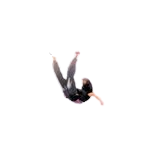
Chou Shu-Yi
Chou Shu-Yi is a Taiwanese multimedia artist and choreographer situated in the hybrid performance arena (National Kaohsiung Center for the Arts, 2020a). Shu-Yi has transformed the immersive and conceptual potential of movement and choreography through his experimentation with virtual reality and projection in his movement practice. His works are unique due to his synergy of live and digital environments, creating works that seep through the fourth wall to permeate the lived experiences of the audience. Shu-Yi’s use of digital technology in his practice remains in constant flux, spanning from live theatre works with projected elements (Emptied Memories, 2011) site-specific dance film projections (Break & Break!, 2018), to virtual reality (VR) dance films (Afterimage for Tomorrow, 2018). Within his live works, his immersive approach to forming an audience-performer relationship remains heavily influenced by his work with digital technology. Shu-Yi’s integration of digital technology has allowed for new creative possibilities including manipulation of time and space, international collaboration, and performance on stages inaccessible to live audiences.Shu-Yi uses digital technology in his works Afterimage for Tomorrow (2018) and Break & Break! (2018) to create an immersive world around his choreography in which the boundary between the audience and performer is blurred (Weiwuying Center for the Arts, 2021). Shu-Yi’s use of digital technology is fully integrated in his practice, utilised to allow core conceptual ideas to resonate with disparate audiences rather than as a purely aesthetic choice (Timbrell, 2011). In Afterimage for Tomorrow (2018), Shu-Yi uses cinematic, stereoscopic virtual reality to shift the audience-performer relationship from one of the audience as the protagonist to the audience as an observer. Shu-Yi begins the film by positioning the viewer as the protagonist by choreographing with them as the centre, oftentimes virtually surrounding the viewer with performers and integrating performer-audience interactions (Weiwuying Center for the Arts, 2021). Shu-Yi’s choice of camera movement including a dolly shot through two lines of performers, mimics the experience of walking through the work, creating a sense of interactivity between the audience and the environment despite the viewer being unable to walk to specific locations in the virtual world (Weiwuying Center for the Arts, 2021). By positioning the viewer as the protagonist, Shu-Yi incites us to recognise the transient and dubious nature of our own memories and reality (Weiwuying Center for the Arts, 2021). Shu-Yi then switches the role of the audience to one of an observer, removing the viewer from the centre and establishing a fourth wall between the viewer and mise en scène, allowing us to view the constructed world with increased objectivity, encouraging conceptual analysis through use of Verfremdungseffekt (Schall, 2015). By switching between these two audience-performer relationships using virtual reality, Shu-Yi allows for both an emotional and experiential resonance with, as well as an objective analysis of the subject through the work.
Afterimage for Tomorrow (2018)
Break & Break! (2018) is a site-specific exhibition centred around exploring the state of uselessness and ruin after a place encounters unavoidable change (Project Zero, 2021). The work looks to revitalise these places by participating in the storytelling of these locations through site-specific projection (Project Zero, 2021). Originating as a series of filmed movement responses to derelict environments encountered during his travels, Break & Break! (2018) uses site-specific projection to reinforce and recontextualise the physical dialogue between Shu-Yi’s physicality and the disenfranchised environment. The video projection’s semi-opaque nature allows Shu-Yi’s movement to transform with the textures of the environment - allowing him to digitally embody the landscape’s dilapidation. Simultaneously, by projection mapping his recorded movement onto a barren, derelict landscape, the environment adopts the dynamism of his movement with neglected characteristics of the environment foregrounded with light and animated with video. By immersing viewers in a three-dimensional projection mapped environment with the freedom to explore the ruins of Polymer - a neglected textile mill, and Son Veng - an abandoned shipyard, Shu-Yi instils in the audience a renewed sense of engagement and exploration with the distressed landscape - allowing the place to be rebirthed with new stories and life (Project Zero, 2021).
Break & Break! (2018)
Shu-Yi’s practice is situated in the hybrid performance arena, predominantly experimenting with digital projection and VR as a means of connecting the audience with the work on both a conceptual and aesthetic level (Mokotow, 2007). Shu-Yi’s works are unique due to his ability to foster symbiotic relationships between live and new media art forms including virtual reality and projection, allowing for digital experiences to synergise with the viewer’s experience of the live work (Timbrell, 2011). Unlike other VR dance works including Co3’s Four by Four (2020) and Lily Baldwin’s Through You (2017) where although the VR environment is immersive, the works preserve the performer-audience hierarchy present in live theatre works, situating the viewer behind a fourth wall, Shu-Yi actively includes the viewer within the narrative, hybridising live and virtual environments to create seamless immersive experiences. For example, in the Weiwuying screening of his VR dance film Afterimage for Tomorrow (2018), Shu-Yi physically transforms the live screening space into the setting of the final scene so that when audiences remove their VR headset they would be transported to the filmic universe, unable to differentiate between virtual and reality (Schildermans, 2022). To further extend the immersive experience, the narrative of the film was also connected between live and virtual environments, with the same dancer imprisoned in the film, dancing live around the audience captive behind a glass wall after VR headsets were removed (Schildermans, 2022). Shu-Yi allows the digital experiences of the viewer to permeate into a live setting, differentiating from other VR dance works by fostering a symbiotic relationship between live and digital performance elements.
In Emptied Memories (2011), Shu-Yi fosters an interdependent relationship between projection and live performance, differentiating from other hybrid works by innovating how projection relates to movement, set design, and conceptual rationale. Unlike works including Sila Sveta’s Levitation (2016) which use projection of computer-generated graphics as a means of adding visual interest to a blank live set and exaggerate the dancer’s movements, Shu-Yi’s Emptied Memories (2011) fully integrates projection with the set design, constructing a series of remote controlled panels that transform two-dimensional projections into a three-dimensional performance environment (Chou, 2013). By doing so, Shu-Yi bypasses the spatial limitations of using projection, allowing the dancer to escape the two-dimensionality of movement catered for projections and allows for manipulation of the performer-projection relationship. By situating the performer in-between semi-opaque projection screens, Shu-Yi shifts the performer-projection relationship, with the audience viewing both the performer being projected on and casting shadows on the projection screen as well as the performer silhouetted behind the semi-opaque projection screen, creating a sense of depth which immerses the performer in the projected scenery. The projection also plays a clear role in the work’s exploration of the degradation of the protagonist’s mental landscape (Chou, 2013). Using sensors and three-sixty video, Shu-Yi conveys the initial mental landscape of the protagonist, through use of sensors and three-sixty video to mimic the observational scanning of the protagonist in real time (Emptied Memories, 2011). As the narrative proceeds and the protagonist’s mental landscape degrades, the projection and set design distorts and evolves to convey the context of the performer’s movement including mimicking the movement of the protagonist through the landscape by situating the performer between two projection screens where a continuous tracking shot is projected to create the illusion of movement (Emptied Memories, 2011). Shu-Yi innovates his use of projection, manipulating the performer-projection relationship as well as increasing its integration into set design and the work’s concept.
Emptied Memories (2011)
Over time, Shu-Yi’s link to digital technology in his practice has evolved from live works including Visible City, People Filled with Air (2007) and (1875) Ravel and Bolero (2006), to hybrid digital and live works including Emptied Memories (2011) and Break & Break! (2018) before experimenting with fully digital works including his VR dance film Afterimage for Tomorrow (2018). Shu-Yi uses digital technology as a tool for fostering closer relationships between the audience and his conceptual explorations through audience immersion (Timbrell, 2011). However, when digital technology or audience immersion is no longer relevant to his intention, he is not afraid to depart from its use. For example, Shu-Yi’s latest work The Center (2021) strips back his use of technology, using a blackbox theatre space and stage lighting to interrogate the accessibility of society to people with disabilities, collaborating with disabled playwright Cheng Chih-Chung (NTCH, 2021). Unlike Afterimage for Tomorrow (2018) which was strongly narrative-driven, Shu-Yi intends the audience to focus on the difference in physicality of the performers in The Center (2021), thus, he has minimised use of digital technology to allow audience observation to drive his dissection of the disparity between abled and disabled experiences in society (NTCH, 2021). However, Shu-Yi’s work with digital technology has influenced his approach to creating live works. For example, Bolero in Kaohsiung (2022), his outdoor site-specific rework of his 2006 work (1875) Ravel and Bolero, integrates multiple elements that aid audience immersion in the digital sphere in an outdoor site-specific context. By allowing the audience to surround and travel through the work, integrating organic interactions between performers and the audience and using costuming that camouflages into the pedestrian crowd, Shu-Yi transforms (1875) Ravel and Bolero (2006) into an immersive experience informed by his work in the VR sphere (National Kaohsiung Center for the Arts, n.d). Shu-Yi often develops his works by extending them through remounts with new live or digital elements, exemplifying the non-linear evolution of digital technology’s role in his practice. In his works Break & Break! (2018) and Afterimage for Tomorrow (2018), Shu-Yi added live components to the site-specific video projection and VR film respectively, to further the immersive potential of his digital works (Chou Shu-Yi周書毅, 2020; Schildermans, 2022). Shu-Yi also added digital elements to his 2007 site-specific work Visible City, People Filled with Air, presenting Visible and Invisible (2014), a theatrical production which uses digital projection to explore and convey the same themes of invisible urban change (MoCA Taipei, 2009; Chou Shu-Yi周書毅, 2014).
The Center (2021)
Bolero in Kaohsiung (2022)
Visible and Invisible (2014)
Visible City, People Filled with Air (2007)
Shu-Yi’s use of digital technology has completely transformed the performance and dance creation possibilities of his work by allowing for international collaboration, manipulation of space and time, heightened audience immersion, and performance on unprecedented stages. During 2020 COVID-19 lockdowns, Shu-Yi in collaboration with National Kaohsiung Center for the Arts launched a mobile application ‘Weiwuying ONE Minute VR Stage - Film Your Own Dance’ which allowed users to film their own VR Screendance films to be presented at the art centre in a work coordinated by Chou Shu-Yi (National Kaohsiung Center for the Arts, 2020b). The project allowed for Shu-Yi to collaborate with anyone who used the app regardless of their location or artistic experience, transforming the collaborative potential of his dance creation process. Shu-Yi’s use of VR and three-sixty video including in Afterimage for Tomorrow (2018) and Between Being Asleep and Awake (2015) allows for manipulation of space and time, creating non-realities through distortion, camera movement, and colouring that fully immerse audiences in an illusory world - an achievement which would be extremely difficult without the use of digital technology (狠主流, 2015). Shu-Yi’s use of projection also allowed his works to be presented on unconventional stages including in Break & Break! (2018) where his movement could be presented on shipyard ruins, dilapidated textile mills and distressed walls - conveying the connection between his movement and the destruction of the landscape without the physical risk of performing live on those stages. Digital technology has transformed the creative process and performance potential of Shu-Yi’s work, enabling him to reach new heights of creative exploration, collaboration and audience immersion across his works.
Weiwuying ONE Minute VR Stage - Film Your Own Dance (2020)
Between Being Asleep and Awake (2015)
Shu-Yi has transformed the immersive and conceptual potential of his movement and choreography over time with his integration of VR and projection into his practice. His explorations in the new media hybrid arts realm has permeated into his live works which similarly preserve the immersive characteristic of his digital works. Shu-Yi differentiates himself from other dance artists in the new media arts realm by synergising live and digital components of his practice to convey a consistent conceptual theme and intent, innovating how his performers interact with the digital technology and developing the role of digital technology in his work beyond that of aesthetic embellishment (Timbrell, 2011). Digital technology has transformed the collaborative, immersive, and staging potential of his choreographic works, allowing Shu-Yi to collaborate with artists of varying experience and at different locations, experiment with full immersion of the audience into an alternative digital world as well as allow his performers to perform on unconventional stages.
WC: 2097
References
Chou Shu-Yi周書毅. (2014). 2014《看得見的城市,看不見的人 》 Visible and Invisible / 周先生與舞者們 [Video]. YouTube. https://www.youtube.com/watch?v=JiCSV_P8BQo&list=PL0FXyygRBZJQnxe6FZjlKvb31GVqi70LQ
Chou Shu-Yi周書毅. (2020). 下一步消逝 / Break & Break! 無用之地_周書毅身體錄像展 Chou Shu-Yi Live Exhibition_Macau 澳門 [Video]. YouTube
. https://www.youtube.com/watch?v=a4wj50fc_F4&list=PL0FXyygRBZJT6pSyFj7bQIjuHOKn2T9yY
Chou, Y. (2013). Emptied Memories digital installational performance [Video]. YouTube. https://www.youtube.com/watch?v=2pK6VyEvsOY
Emptied Memories. (2013). 《空的記憶》3min演出精華 [Video]. YouTube. https://www.youtube.com/watch?v=fwp917w5QuY&list=PL9CB7F2B8356D8E99&index=27
Co3 Contemporary Dance. (2021). Four by four. https://co3.org.au/show/fourbyfour/
MoCA Taipei. (2009). 第七屆台新藝術獎_入圍者專訪_周書毅【 看得見的城市,人 充滿空氣】( 上) [Video]. YouTube. https://www.youtube.com/watch?v=4KaynbORab4
Mokotow, A. (2007). WHY DANCE: The impact of multi arts practice and technology on contemporary dance [Master's thesis]. https://rest.neptune-prod.its.unimelb.edu.au/server/api/core/bitstreams/20614279-46a0-5b29-9d8b-0e7d2d4bf3e7/content
National Kaohsiung Center for the Arts. (2020a). Weiwuying Artist-in-Residence-CHOU Shu-Yi. https://www.npac-weiwuying.org/news/5f45aad1f8c7db0006777b3e?lang=en
National Kaohsiung Center for the Arts. (2020b). Weiwuying ONE Minute VR Stage - Film Your Own Dance. https://www.npac-weiwuying.org/programs/5f45aad1f8c7db0006777b3e?lang=en
National Kaohsiung Center for the Arts. (n.d.). Bolero in Kaohsiung. https://www.npac-weiwuying.org/programs/618ce3354490a40007918ccb?lang=en
NTCH. (2021). Taiwan Week 2021: Chou Shu-yi talks about The Center [Video]. YouTube. https://www.youtube.com/watch?v=ykoAV9jsREQ
Project Zero. (2021). Break & Break! https://www.projectzerotw.com/en/break-break/
Schall, E. (2015). The craft of theatre: Seminars and discussions in Brechtian theatre. Bloomsbury Publishing.
Schildermans, J. (2022). A necessary transformation: the performing arts and VR in Taiwan. Springback. https://springbackmagazine.com/read/performing-arts-vr-film-taiwan/
Timbrell, H. M. (2011). The synergy of visual projections and contemporary dance [Master's thesis]. https://ro.ecu.edu.au/theses_hons/1366/
Weiwuying Center for the Arts. (2021). 「當周書毅與你彼此凝視...你的身體是如何被我們帶進VR宇宙」陳芯宜導演談《留給未來的殘影》 [Video]. YouTube. https://www.youtube.com/watch?v=42F-8-ibudw
WHYIXD. (n.d.). Emptied memories. https://www.whyixd.com/emptiedmemories2011/rqnmrm4196ct42456l6clnrpzhjki5
狠主流. (2015). Between being asleep and awake (PANORAMIC VIEW) 睡與醒之間 [Video]. YouTube. https://www.youtube.com/watch?v=bvg1XE5wLmE&list=PL0FXyygRBZJQnxe6FZjlKvb31GVqi70LQ&index=4